Original Source:The Tale of the Bamboo Cutter (Taketori Monogatari, 竹取物語) Period: Approximately the 10th Century (Japan’s Heian Period)
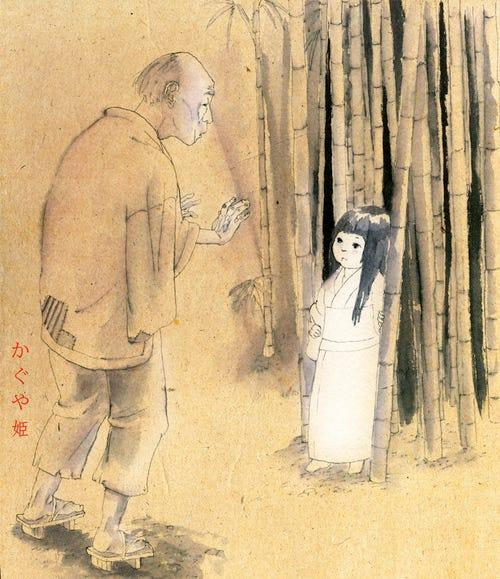
Long ago, an elderly bamboo cutter made his living by harvesting bamboo in the mountains.
One day, he noticed an extraordinary bamboo stalk glowing with a brilliant golden light. When he split it open, he discovered a tiny, beautiful baby girl no larger than the palm of his hand.
Believing the child to be a gift from heaven, the old man and his wife brought her home and lovingly raised her as their own daughter. They named her Princess Kaguya (Kaguya-hime, かぐや姫).
From that day forward, every time the bamboo cutter entered the forest, he found pieces of pure gold hidden inside the bamboo stalks. Thanks to these miraculous treasures, the once-poor family gradually became wealthy.
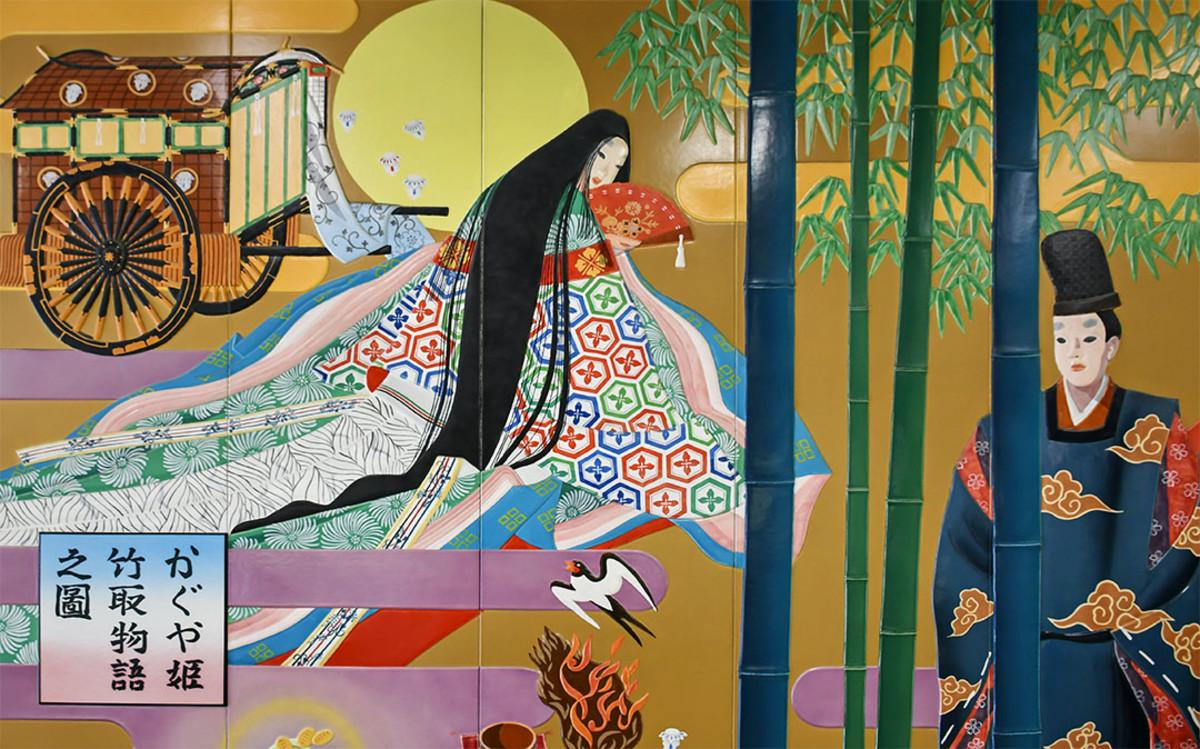
Princess Kaguya grew at an astonishing rate. Within only a few months, she had become a young woman of extraordinary beauty.
Her elegance and grace seemed almost supernatural, as though she did not truly belong to the human world.
News of her beauty spread throughout Japan, attracting countless noblemen and aristocrats who wished to marry her.
Despite their admiration and persistence, Princess Kaguya rejected every proposal.
To discourage her suitors, Princess Kaguya assigned each of five noblemen an impossible quest.
She asked them to obtain legendary treasures, including:
The Stone Begging Bowl once used by the Buddha.
A jeweled branch from the mythical Isle of Hōrai, the legendary land of immortality.
The Fire Rat’s Robe, said to be immune to flames.
The Five-Colored Jewel from the head of a dragon.
The Magical Cowrie Shell hidden inside a swallow.
These sacred objects existed only in myths and legends.
Some of the noblemen attempted to deceive her with counterfeit treasures, while others risked dangerous journeys in search of the impossible. Several returned empty-handed, and some were injured or even lost their lives.
In the end, none of them succeeded.
Eventually, stories of Princess Kaguya reached the Emperor himself.
Unlike the other suitors, the Emperor neither deceived nor pressured her. Instead, he sincerely expressed his admiration and affection.
Although Princess Kaguya respected the Emperor deeply, she gently refused his proposal, knowing that she could never remain in the human world.
The two continued exchanging letters, maintaining a relationship built on mutual respect and understanding, yet they were destined never to become husband and wife.
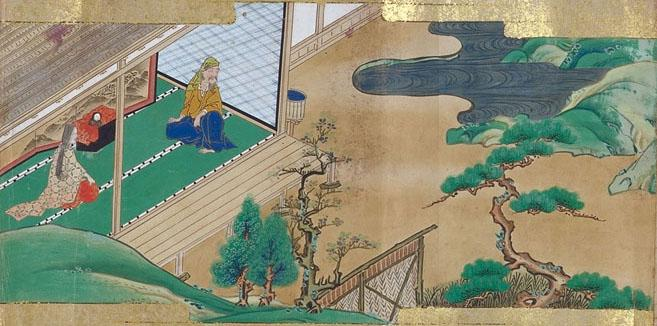
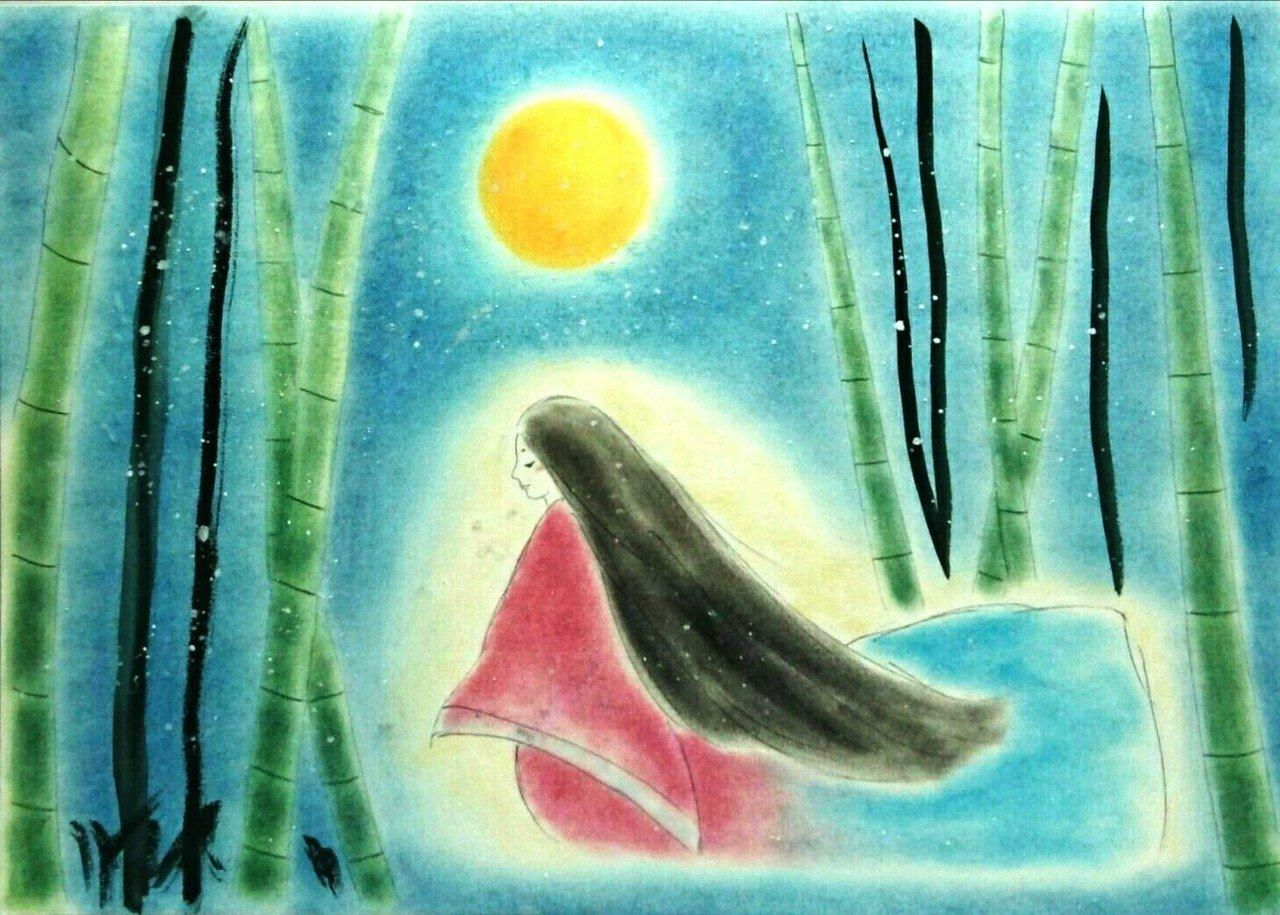
As time passed, Princess Kaguya often gazed silently at the full moon with deep sadness.
Her adoptive parents sensed that she was hiding a painful secret.
At last, she revealed the truth.
She was not a human being.
She was a celestial maiden from the Moon Capital, sent temporarily to live on Earth. Her time among humans had come to an end, and on the night of the full moon of the fifteenth day of the eighth lunar month, celestial messengers would return to take her back to the Moon.
Heartbroken, her adoptive parents desperately wished to keep her by their side.
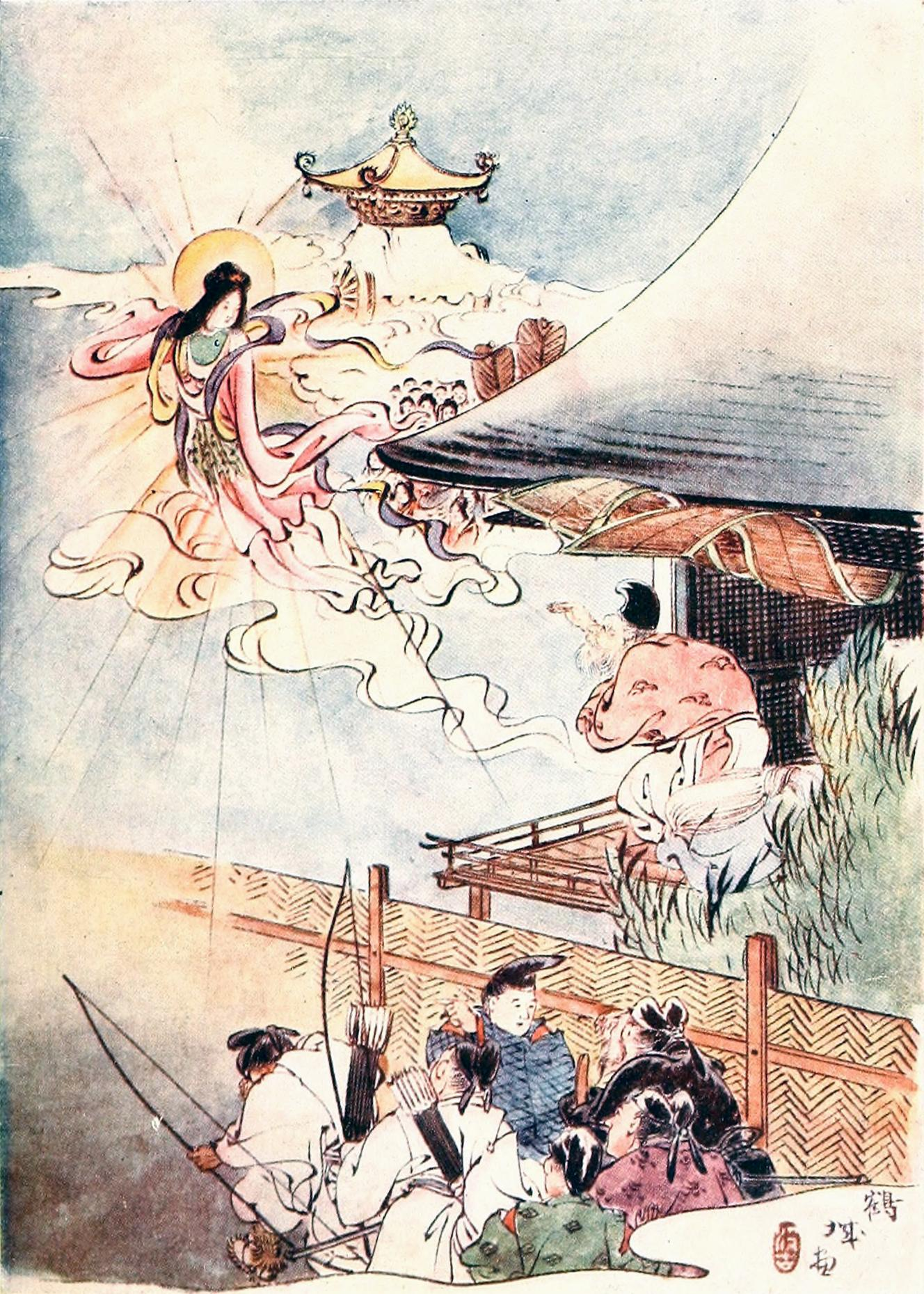
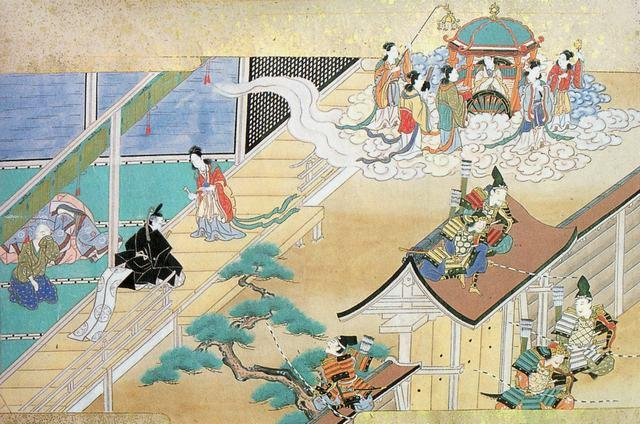
When the Emperor learned of Princess Kaguya’s fate, he ordered a large force of imperial guards to protect her residence and prevent the celestial beings from taking her away.
However, on the appointed night, the sky was filled with dazzling light as heavenly messengers descended from the clouds.
No matter how determined the soldiers were, they could not resist the divine power of the celestial visitors. Every guard became powerless before them.
With tears in her eyes, Princess Kaguya bid a sorrowful farewell to her adoptive parents.
She then put on a sacred celestial robe.
According to the legend, this robe erased all earthly emotions, memories, and sorrow.
As she wore it, her sadness gradually faded. Restored to her true celestial identity, Princess Kaguya returned to the Moon with the heavenly procession.
Before leaving, Princess Kaguya entrusted a letter and a precious Elixir of Immortality (Fushi no Kusuri, 不死の薬) to be delivered to the Emperor.
The gift was meant to express her gratitude and offer him eternal life.
When the Emperor received the elixir, however, he could not bring himself to drink it.
Instead, he declared:
“Now that Princess Kaguya has left this world, what meaning would eternal life have for me alone?”
He ordered one of his most loyal attendants to carry both the letter and the Elixir of Immortality to the highest mountain in Japan and burn them at its summit.
According to Japanese legend, that mountain became Mount Fuji.
People believed that the smoke rising from Mount Fuji was the lingering trace of the immortal elixir burning on its peak.
Another literary interpretation suggests that the name Fuji (ふじ) echoes the pronunciation of Fushi (ふし), meaning “immortality” or “deathlessness,” making Mount Fuji a lasting symbol of eternal life in Japanese culture.
References
The Tale of the Bamboo Cutter (Taketori Monogatari, 竹取物語), anonymous, c. 900–950 CE.
Heian Period Japanese Literature.
National Diet Library of Japan (Classical Manuscript Collections).
作者

longchengfeizhoushuai@gmail.com